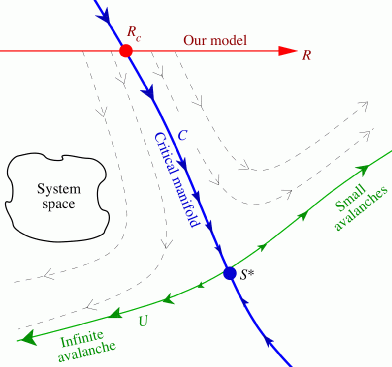
Systems that are undergoing a qualitative change of behavior often look the same on different scales -- they exhibit an emergent scale invariance. Renormalization-group methods discovered largely at Cornell for thermodynamic critical points are now being used to explain emergent scale invariance for the onset of chaos, percolation of oil-bearing porous rock, earthquakes and avalanches at depinning transitions, quantum fluctuations, correlated metals and Fermi liquids, the motion of interfaces, and the flocking of birds, wildebeests, and bacteria. Conversely, new ideas from string theory and mathematics have led to a deeper understanding of critical phenomena.
The course is designed for graduate students in physics who have
taken a semester of graduate-level statistical mechanics.
 Statistical Mechanics: Entropy, Order Parameters, and Complexity,
now available at
Oxford University Press
(USA,
Europe).
Statistical Mechanics: Entropy, Order Parameters, and Complexity,
now available at
Oxford University Press
(USA,
Europe).